Introduction
The digital marketing landscape is evolving faster than ever. For years, businesses have relied on traditional marketing automation tools to streamline email campaigns, schedule social media posts, and nurture leads through predefined workflows. While these tools have improved efficiency, they still require significant human intervention, rule-based programming, and constant optimization.
Today, a new technology is transforming the way businesses engage with customers: Agentic AI.
Unlike traditional automation systems that simply follow instructions, Agentic AI can analyze data, make decisions, adapt strategies, and execute tasks autonomously. This shift is redefining marketing operations and enabling organizations to achieve higher levels of personalization, efficiency, and growth.
What is Traditional Marketing Automation?
Traditional marketing automation refers to software platforms that automate repetitive marketing tasks based on predefined rules and triggers.
Common examples include:
- Email drip campaigns
- Lead nurturing workflows
- Social media scheduling
- CRM-based customer segmentation
- Automated follow-up messages
- Retargeting campaigns
These systems work well but depend heavily on human-created workflows. If customer behavior changes unexpectedly, marketers must manually update the automation rules.
Limitations of Traditional Marketing Automation
- Limited adaptability
- Rule-based decision making
- Requires constant monitoring
- Generic customer experiences
- Slow response to market changes
- Heavy dependence on marketing teams
As customer expectations continue to rise, these limitations are becoming more apparent.
What is Agentic AI?
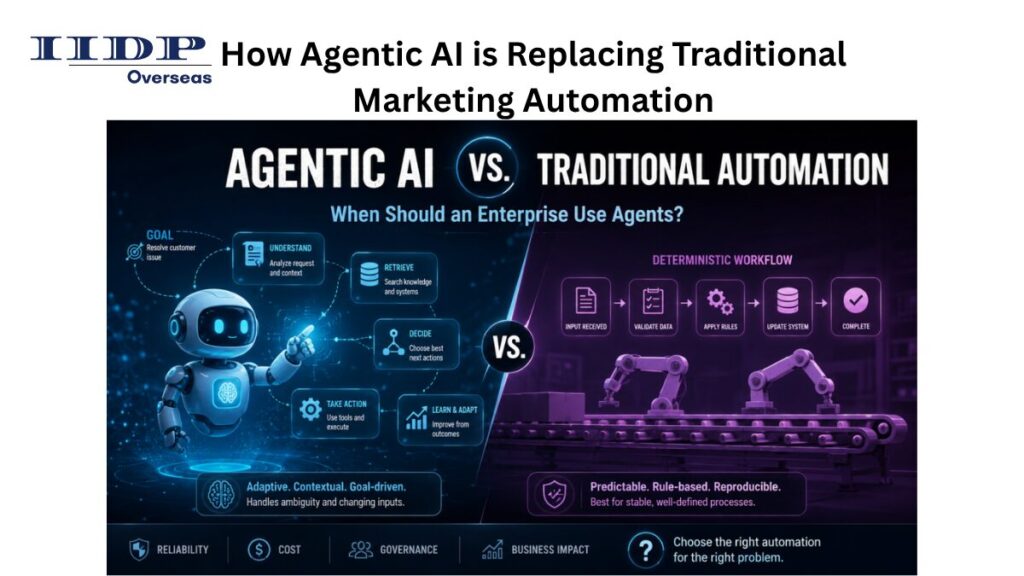
Agentic AI refers to artificial intelligence systems capable of independently planning, reasoning, learning, and taking action to achieve specific goals.
Rather than waiting for instructions, Agentic AI can:
- Analyze customer behavior in real time
- Identify opportunities and challenges
- Create marketing strategies
- Execute campaigns autonomously
- Optimize performance continuously
- Learn from outcomes and improve over time
Think of traditional automation as a GPS following a fixed route, while Agentic AI acts like an experienced driver who can choose the best route based on real-time traffic conditions.
How Agentic AI is Transforming Marketing
1. Autonomous Campaign Management
Traditional automation requires marketers to set up workflows manually.
Agentic AI can:
- Build campaigns automatically
- Adjust targeting strategies
- Modify ad creatives
- Reallocate budgets
- Optimize campaign performance
This reduces manual effort and improves overall efficiency.
2. Hyper-Personalization at Scale
Consumers expect personalized experiences.
Agentic AI analyzes:
- Browsing behavior
- Purchase history
- Customer preferences
- Engagement patterns
- Real-time interactions
It then delivers highly relevant content, offers, and recommendations to each individual customer.
3. Intelligent Lead Nurturing
Instead of moving leads through predefined funnels, Agentic AI dynamically adjusts communication based on customer intent.
Benefits include:
- Higher conversion rates
- Better lead qualification
- Improved customer engagement
- Faster sales cycles
4. Real-Time Decision Making
Traditional systems react to predefined triggers.
Agentic AI proactively identifies opportunities and responds instantly to changing market conditions, customer behavior, and competitor actions.
5. Content Creation and Optimization
Modern AI agents can:
- Generate blog posts
- Write email campaigns
- Create ad copy
- Produce social media content
- Optimize headlines and CTAs
This significantly reduces content production time while maintaining quality.
Agentic AI vs Traditional Marketing Automation
Feature | Traditional Automation | Agentic AI |
Decision Making | Rule-Based | Autonomous |
Learning Ability | Limited | Continuous Learning |
Personalization | Segmented | Individualized |
Adaptability | Low | High |
Human Intervention | High | Minimal |
Campaign Optimization | Manual | Automatic |
Real-Time Response | Limited | Advanced |
Benefits of Agentic AI for Businesses
Increased Efficiency
AI agents can manage multiple campaigns simultaneously, reducing workload and operational costs.
Better Customer Experience
Personalized interactions improve customer satisfaction and brand loyalty.
Higher ROI
Continuous optimization helps businesses maximize marketing performance and revenue.
Faster Decision Making
Real-time analysis enables quicker responses to market trends and customer behavior.
Scalability
Businesses can expand marketing efforts without proportionally increasing team size.
Industries Already Adopting Agentic AI
Many industries are rapidly integrating Agentic AI into their marketing operations:
- E-commerce
- Education & EdTech
- Healthcare
- Real Estate
- Finance
- SaaS Companies
- Travel & Hospitality
Organizations using Agentic AI are gaining a significant competitive advantage through smarter customer engagement and data-driven decision making.
Challenges of Agentic AI Adoption
While Agentic AI offers tremendous benefits, businesses should also consider:
Data Privacy
AI systems require access to customer data, making compliance with privacy regulations essential.
Implementation Costs
Initial setup and integration may require investment in technology and training.
Human Oversight
Although AI can operate independently, strategic oversight remains necessary to ensure alignment with business goals.
Ethical Considerations
Organizations must ensure transparency, fairness, and responsible use of AI-driven decisions.
The Future of Marketing is Agentic
The transition from traditional marketing automation to Agentic AI represents one of the most significant shifts in digital marketing history.
Businesses that embrace Agentic AI will benefit from:
- Smarter decision making
- Greater personalization
- Improved customer experiences
- Increased operational efficiency
- Sustainable competitive advantage
As AI technology continues to evolve, marketers will move from manually managing campaigns to supervising intelligent AI agents that execute and optimize marketing strategies autonomously.
Conclusion
Traditional marketing automation has served businesses well for many years, but its rule-based nature limits its ability to adapt in today’s fast-changing digital environment.
Agentic AI is changing the game by enabling systems to think, learn, decide, and act independently. From personalized customer journeys to autonomous campaign optimization, Agentic AI is not just improving marketing automation—it’s replacing it.
Organizations that adopt Agentic AI today will be better positioned to lead the future of digital marketing tomorrow.