Introduction
Today’s customers expect personalized, seamless, and timely experiences across every digital touchpoint. Whether they’re browsing a website, opening an email, clicking an advertisement, or interacting with a chatbot, they expect brands to understand their needs and provide relevant solutions.
Traditional customer journey mapping has long relied on predefined workflows and manual optimization. However, with the rise of Artificial Intelligence (AI), businesses can now create self-optimizing customer journeys that continuously learn, adapt, and improve based on real-time customer behavior.
This shift is helping companies increase engagement, improve customer satisfaction, boost conversions, and maximize marketing ROI.
In this blog, we’ll explore how AI is transforming customer journeys and why self-optimizing experiences are becoming the future of digital marketing.
What is a Customer Journey?
A customer journey is the complete path a customer takes while interacting with a business—from discovering a brand to becoming a loyal customer.
A typical customer journey includes:
Awareness
Consideration
Decision
Purchase
Onboarding
Retention
Advocacy
Every interaction during these stages influences whether a customer continues engaging with the brand.
What Are Self-Optimizing Customer Journeys?
A self-optimizing customer journey uses Artificial Intelligence to monitor customer interactions, analyze behavior, predict future actions, and automatically improve marketing strategies without requiring constant manual intervention.
Instead of relying on fixed workflows, AI dynamically adjusts the customer experience based on:
User behavior
Purchase history
Website interactions
Email engagement
Device usage
Location
Customer preferences
Real-time intent
The result is a highly personalized journey that evolves with every customer interaction.
Why Traditional Customer Journeys Fall Short
Traditional marketing automation follows predefined rules.
For example:
If a customer downloads an eBook, send Email A.
If they open the email, send Email B.
If they don’t respond, send a reminder.
While this approach is useful, it has limitations:
One-size-fits-all workflows
Limited personalization
Manual optimization
Delayed responses to customer behavior
Inability to predict customer intent
As customer expectations continue to rise, these rigid workflows struggle to deliver the personalized experiences people expect.
How AI Creates Self-Optimizing Customer Journeys
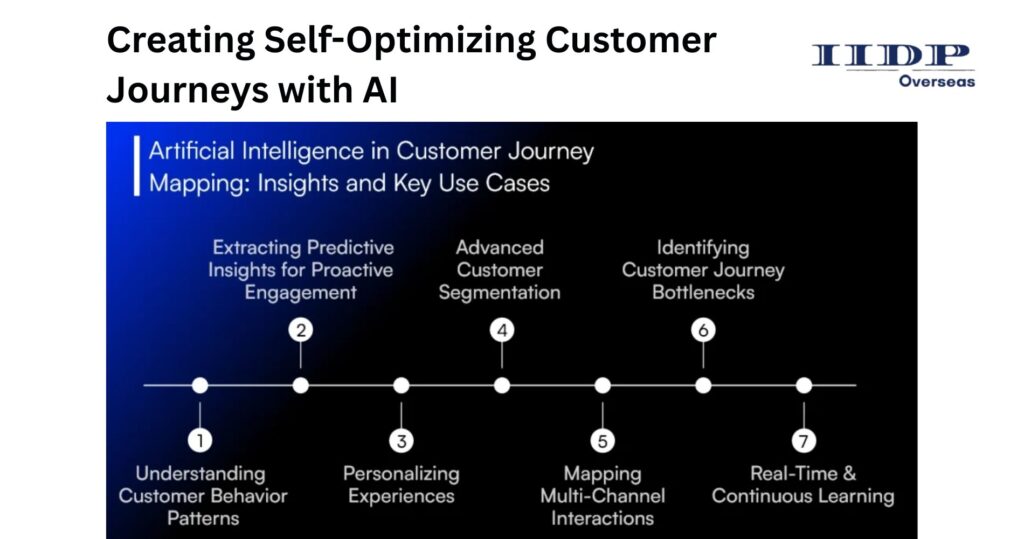
1. Real-Time Customer Behavior Analysis
AI continuously tracks customer interactions across multiple channels, including:
Website visits
Search behavior
Product views
Email clicks
Social media engagement
Chatbot conversations
Instead of waiting for marketers to analyze reports, AI identifies patterns instantly and recommends the next best action.
2. Predictive Customer Intent
AI doesn’t just analyze past behavior—it predicts future actions.
For example, it can identify customers who are likely to:
Make a purchase
Abandon their cart
Cancel a subscription
Upgrade a service
Become repeat buyers
Businesses can proactively engage these users with relevant offers and personalized messaging.
3. Personalized Content Delivery
AI selects the most relevant content for each customer based on their interests and behavior.
Examples include:
Personalized product recommendations
Dynamic landing pages
Customized email campaigns
Targeted advertisements
Tailored blog suggestions
This increases engagement and improves the overall customer experience.
4. Intelligent Channel Selection
Different customers prefer different communication channels.
AI determines whether to engage users through:
Email
SMS
WhatsApp
Push notifications
Social media
Chatbots
It also identifies the best time to deliver each message for maximum impact.
5. Continuous Journey Optimization
Unlike traditional workflows, AI continuously measures performance and adjusts strategies automatically.
It can optimize:
Email subject lines
Call-to-action buttons
Landing page content
Ad creatives
Audience segmentation
Marketing budgets
This ensures the customer journey becomes more effective over time.
Benefits of AI-Powered Customer Journeys
Higher Personalization
Customers receive relevant experiences tailored to their interests and behavior.
Better Customer Engagement
Personalized interactions encourage users to spend more time engaging with your brand.
Increased Conversion Rates
Delivering the right message at the right time significantly improves purchase decisions.
Improved Customer Retention
AI identifies at-risk customers and recommends actions to improve loyalty before they disengage.
Reduced Marketing Costs
Automation minimizes manual work while improving campaign efficiency and return on investment.
Faster Decision Making
Real-time insights enable businesses to respond quickly to changing customer needs.
Real-World Applications
Businesses across industries are using AI to enhance customer journeys.
E-commerce
Product recommendations
Personalized offers
Cart recovery campaigns
Dynamic pricing
Education
Personalized course recommendations
Student engagement tracking
Automated admissions support
Learning progress insights
Healthcare
Appointment reminders
Personalized wellness content
Patient follow-ups
Predictive care recommendations
Banking and Finance
Fraud detection
Personalized financial advice
Credit recommendations
Customer support automation
SaaS Businesses
Onboarding guidance
Feature recommendations
Churn prediction
Usage-based engagement
Best Practices for Building AI-Driven Customer Journeys
To maximize results, businesses should:
Collect accurate and permission-based customer data.
Integrate data from CRM, website analytics, email marketing, and customer support platforms.
Use AI tools that provide predictive analytics and automation.
Continuously test and refine customer experiences.
Maintain transparency about how customer data is collected and used.
Combine AI insights with human creativity and strategic oversight.
Challenges to Consider
Although AI offers powerful capabilities, businesses should also address:
Data Privacy
Protect customer information and comply with regulations such as GDPR and other applicable privacy laws.
Data Quality
AI performs best when trained on accurate, consistent, and up-to-date data.
Human Oversight
AI can automate decisions, but marketers should monitor outcomes to ensure they align with business goals and customer expectations.
Ethical AI
Avoid biased decision-making and ensure customers understand when they are interacting with AI-driven systems.
The Future of Customer Journeys
As AI technologies continue to evolve, customer journeys will become even more intelligent.
Future developments may include:
Autonomous AI marketing agents
Emotion-aware personalization
Predictive customer service
Hyper-personalized shopping experiences
AI-generated content tailored in real time
Seamless omnichannel engagement across every customer touchpoint
Businesses that embrace these innovations will be better positioned to build stronger relationships and long-term customer loyalty.
Conclusion
AI is transforming customer journeys from static, rule-based workflows into intelligent, self-optimizing experiences that continuously adapt to customer needs.
By analyzing behavior, predicting intent, personalizing interactions, and optimizing every touchpoint, AI helps businesses deliver exceptional customer experiences while improving efficiency and increasing conversions.
Companies that invest in AI-powered customer journey optimization today will be better equipped to meet rising customer expectations and stay competitive in the rapidly evolving digital marketplace.